AI headphones are evolving from "listening" to "seeing".
The global headphone market is at a structural inflection point: the growth of traditional TWS has peaked — according to data from LooTuu, China's headphone market shipped 87.97 million units in the first half of 2026, a year-on-year decline of 15.9%. At the same time, AI headphones have become the only high-growth track, with the global market size expected to grow from 7.42 billion US dollars in 2026 to 17.34 billion US dollars in 2030 (Research and Markets).
More critical changes are taking place in architecture and form factors:
End-cloud collaboration has become the mainstream architecture: light tasks such as noise cancellation and wake-up are processed on the end side, while intelligent tasks such as comprehension and summarization are processed on the cloud. This means that the core task of the headphone-side chip is not "computing", but perceiving and collecting information with high quality and low power consumption — delivering visual information cleanly to the main control unit and the cloud.
Headphones are a proven AI carrier: third-party surveys show that consumers' acceptance of "headphones with cameras" reaches 93.3%, significantly higher than that of the glasses form factor (62.7%). Without requiring changes to wearing habits, headphones are a more natural portable AI "eye" than glasses.
Cameras are becoming a new standard feature for flagship headphones: leading international brands have successively introduced cameras to their headphones, positioning them as environment perception sensors (recognizing faces, objects, texts and scenes to provide visual context for AI assistants) rather than photography tools.
For ISP chips, this means an unprecedented set of stringent requirements: extremely small package, extremely low power consumption, extremely simplified BOM, and all-weather standby. The Ingenic CW020 series is born precisely for this purpose.
As one of the smallest wearable ISP solutions in the industry, the CW020 series adopts an extremely compact 2×5.5mm (11mm²) package and a DDR-less architecture. It is specially built for ultra-small space wearable devices such as headphones and glasses, providing a critical visual entry solution for the environment-aware headphone category that is moving from concept to shelf.
Product Specifications
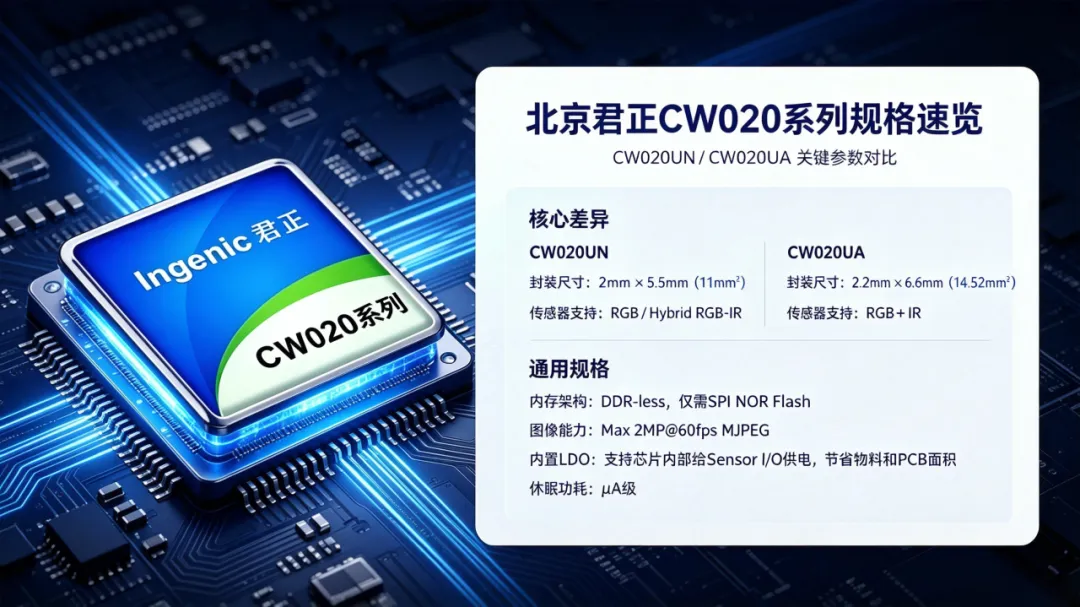
Item | CW020UN | CW020UA |
Package Size | 2mm X 5.5mm (11mm²) | 2.2mm X 6.6mm (14.52mm²) |
Memory Architecture | DDR-less (only requires SPI NOR Flash) | |
Image Capability | Max: 2MP@60fps MJPEG | |
Sensor Support | RGB / Hybrid RGB-IR | RGB+IR |
Built-in LDO | Supports powering the Sensor I/O from inside the chip, saving materials and PCB are | |
Sleep Power Consumption | µA leve | |
Four Core Technical Highlights
One of the world's smallest, 11mm² fits into the headphone stem: The CW020UN has an area of only 11mm² (about the size of a grain of rice), allowing easy layout in spaces that traditional ISPs cannot access, such as headphone stems and temple arms of glasses — this is a key step for camera headphones to evolve from "concepts" to "usable products".
DDR-less architecture directly reduces BOM cost: No DDR/PSRAM is required, only SPI NOR Flash is needed, which reduces storage cost and power consumption simultaneously, clearing the way for mass production of extremely cost-sensitive wearable devices.
Ultra-low power consumption, uncompromising all-weather perception: With a built-in LDO and extremely simplified peripherals, the standby power consumption is as low as µA level; the power consumption for low-frequency environment perception snapshot (VGA@1fps) is less than 3mA.
Flexible options for single-camera and dual-camera: CW020UN focuses on single-camera solutions for ultra-small spaces, while CW020UA supports RGB+IR dual cameras, covering multiple scenarios including environment perception, code scanning, face recognition trigger, and video calls.
Target Scenarios
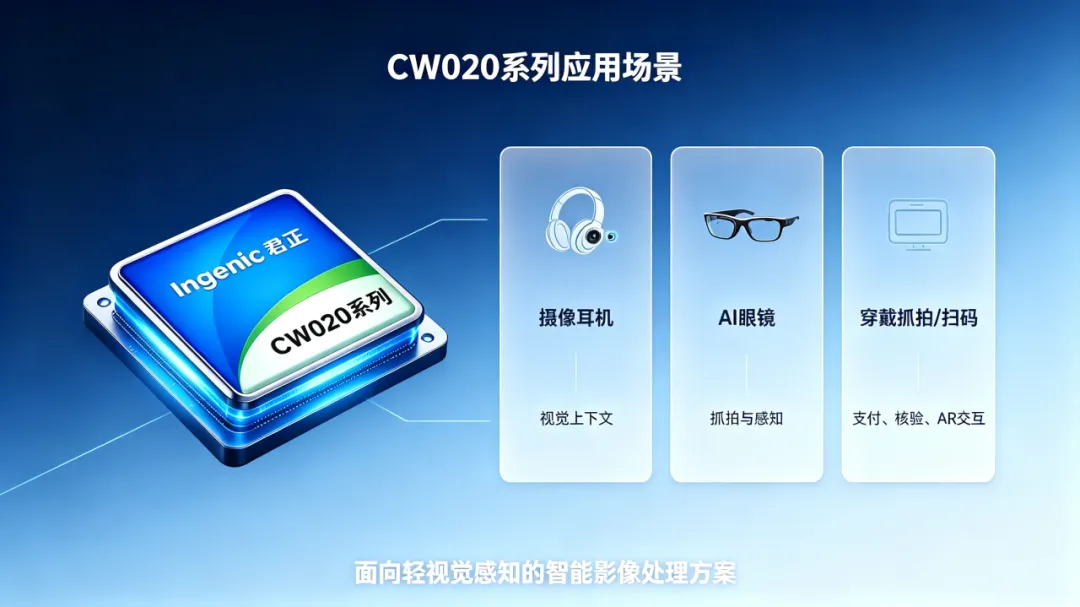
Environment-aware headphones (camera headphones): Perceive the surrounding environment, faces, objects and texts in real time, providing "visual context" for AI assistants — the camera works as a sensor, not a camera for photography.
AI glasses: Snapshot, stream push and perception entry for lightweight visual glasses.
Wearable snapshot and code scanning: Light visual applications such as mobile payment, identity verification, and AR interaction.
Ecosystem and Mass Production Readiness
The CW020 series provides Turnkey solution support: it can adapt to mainstream Bluetooth SoC platforms, and the reference design has reached the delivery standard, helping customers smoothly enter the product design phase and enabling the fastest path from project initiation to mass production.
CW020UN / CW020UA will open sample and evaluation board applications in late September 2026.