The Visual Capability of Wearable Devices Is Not Just About Adding a Camera
AI glasses, camera-enabled earphones, and smart watches have been launched one after another, but few have gained a solid foothold in both user experience and sales. The limited space in temple arms and earphone stems forces batteries to be compressed, creating inherent constraints on heat dissipation. Achieving high-definition shooting, stable anti-shake, and fast snapshot under such physical constraints is difficult for traditional ISP solutions to balance.
CW080, the brand-new defined industry's first flagship AI wearable ISP, was officially released in Q1 2026 — it truly converts the visual capability of thin and light wearable devices into practical functions.
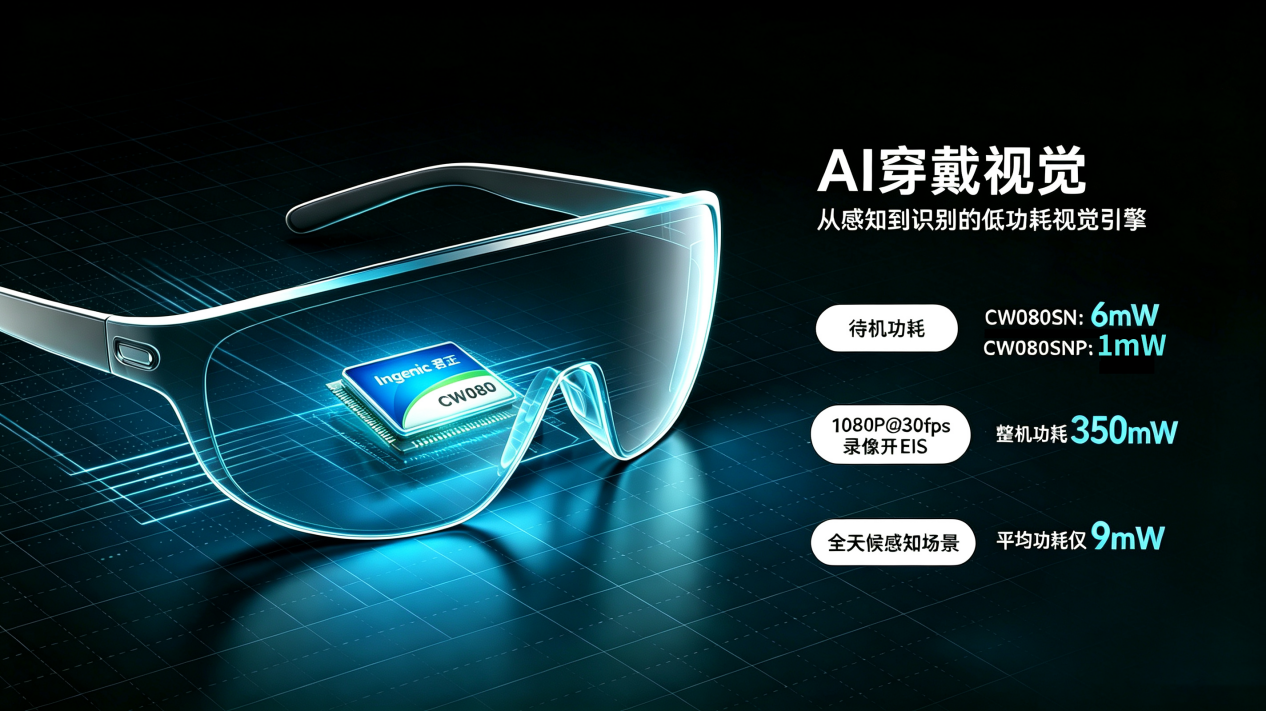
Hierarchical Power Consumption Management, No Waste of a Single Milliwatt
The limited battery life of AI wearable devices stems from two aspects: one is the limited battery capacity; the other is that current solutions for wearable devices have high power consumption, and there is no truly low-power solution that meets the requirements of wearable devices.
CW080 follows a clear idea: focus on image effect presentation, with image acquisition, 4K encoding, and EIS anti-shake processed independently by the ISP; Bluetooth connection, voice interaction, and system scheduling are delegated to the MCU. It enters deep sleep in non-image acquisition modes to eliminate invalid power consumption.
Actual Measured Data of CW080:
1.Standby power consumption:
CW080SN: 6mW
CW080SNP: 1mW
2.1080P@30fps video recording with EIS enabled, overall power consumption 350mW
3.In all-weather perception scenarios, the average power consumption is only 9mW
Powered by a 300mAh battery, the CW080 series can continuously record nearly 100 1-minute videos, or operate continuously for 72 hours in the all-weather real-time perception scenario, while CW080SNP can achieve a standby time of up to 30 days.
7*11mm Package with Built-in DDR, Leaving Sufficient Margin for Structural Design
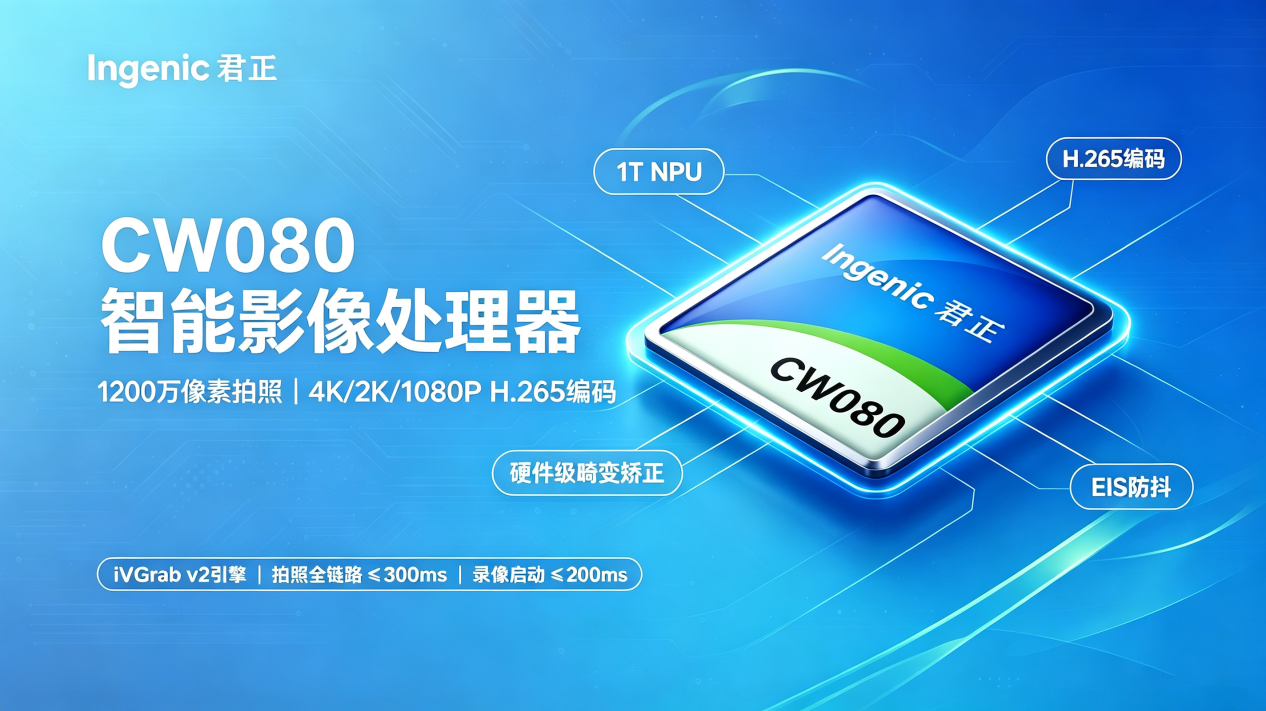
The CW080 adopts a 7*11mm integrated package, with 128MB DDR3 integrated on-chip, eliminating the need for external memory.
The number of peripheral components is reduced, allowing narrower temple arms; the heat dissipation path is optimized, resulting in no obvious temperature rise during long-time video recording; it is compatible with single-camera and dual-camera configurations, covering entry-level to high-end multi-camera devices.
The complete product matrix of the same series: C100 (5×6mm), CW020 (2mm ultra-miniature, to be launched in Q3 2026), CW240 (8nm high-performance high-resolution multi-camera, to be launched in Q2 2027), allowing customers to select models as needed.
Both Imaging Quality and Response Speed Are Delivered
The CW080 supports 12-megapixel photography, 4K/2K/1080P H.265 encoding which halves the video file size. Hardware-level distortion correction, WDR wide dynamic range, 3A algorithms, and EIS anti-shake are all built in. The 1T NPU can handle lightweight AI inference tasks such as object recognition and scene tagging.
Response speed is also a core experience. Traditional solutions generally have a delay of more than 600ms from trigger to imaging. The CW080's self-developed iVGrab v2 engine compresses the full photography link to within 300ms, and the video recording startup is completed within 200ms.
Mass Production & Implementation, One-stop Service
In the wearable chip industry, solution demonstrations are easy, but mass production and implementation are difficult.
In 2025, a number of AI glasses customers completed mass production verification, covering entertainment, business, sports and other tracks, laying a solid foundation for the delivery of CW080:
1.Standardized hardware reference design and PCB layout template, compatible with mainstream Bluetooth MCAs on the market, no need for customers to re-develop the underlying communication protocol;
2.Complete ISP image tuning toolkit, with built-in mature parameters for anti-shake, wide dynamic range, and distortion correction, saving customers 3–6 months of image quality debugging cycle; the underlying drivers for multi-modal interaction connect visual acquisition and data upload, and work with Bluetooth and APP to realize mainstream AI glasses functions such as scene recognition and cloud video synchronization;
3.Exclusive technical support team provides full follow-up services for hardware debugging, trial production and yield optimization, to solve mass production problems in power consumption, image quality, compatibility in a one-stop manner.
More Than Just for AI Glasses
The application scenarios of CW080 cover multiple categories such as AI camera glasses, camera-enabled TWS earphones, smart watches and other lightweight environment perception terminals.
In addition to CW080, the CW020 is also about to be released. With ultra-small size and extreme low power consumption, it takes TWS true wireless Bluetooth earphones as the typical application scenario, endowing earphones with environmental perception, environment recognition and AI interaction capabilities.
Conclusion
The CW080 is not the chip with the most aggressive parameters, but it provides pragmatic solutions in multiple dimensions including power consumption, packaging, imaging, response, and mass production.
CW080 will be officially supplied in bulk in the third quarter of 2026. Later, together with CW020 and CW240, it will form a gradient complete wearable vision chip product matrix, fully covering high, medium and low full price ranges of intelligent terminals, and providing scenario-based and layered chip solutions for various intelligent wearable vision devices.