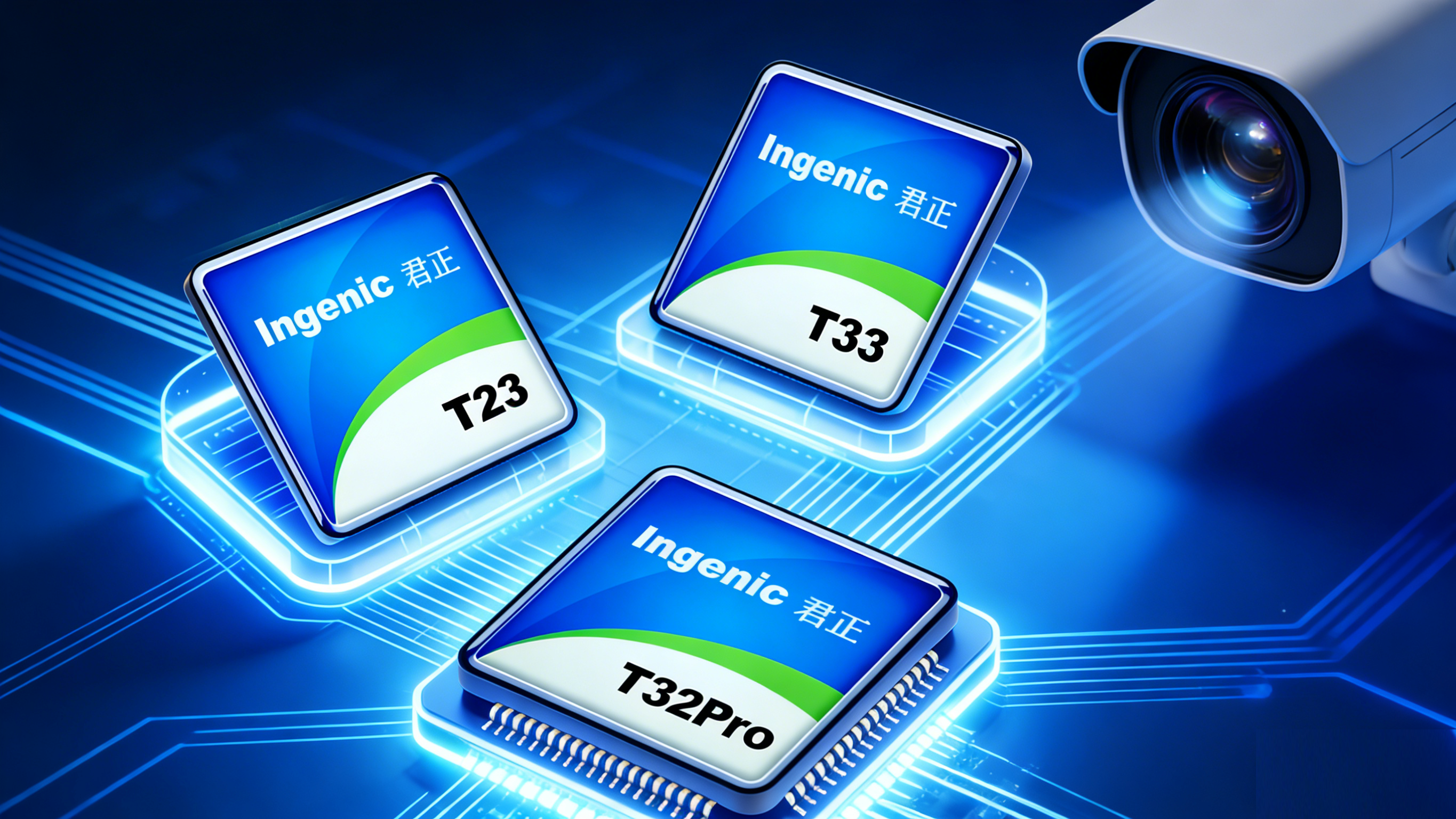
Beijing Ingenic's T23, T33, and T32Pro series intelligent vision processors are all oriented towards video equipment application scenarios, covering mobile cameras, security surveillance, video conferencing, video analysis, and other fields. These three processor series are based on different product positioning, forming a product matrix ranging from high-cost-performance entry-level to mid-to-high-end professional levels. They each have their own emphasis on performance, power consumption, and functional characteristics, while maintaining hardware compatibility and software ecosystem consistency to meet the development needs of products at different tiers.
I. Core Technical Parameter Comparison
1.1 Processor Core and AI Computing Power
Technical Parameter | T23 Series | T33 Series | T32Pro Series |
CPU Architecture | Xburst®1, MIPS32 ISA | Xburst®1, MIPS32 ISA + SIMD128 Instruction Set | Xburst®1, MIPS32 ISA + SIMD128 Instruction Set |
CPU Clock Speed | 1.2GHz ~ 1.4GHz | 1.0GHz | 1.2GHz |
Cache Configuration | 16K I-Cache + 16K D-Cache, 64KB L2 Cache | 32KB I-Cache + 32KB D-Cache, 128KB L2 Cache | 32KB I-Cache + 32KB D-Cache, 128KB L2 Cache |
MCU Configuration | 600MHz RISC-V Co-processor, supports RV32IMC instruction set | 600MHz RISC-V Co-processor, supports RV32IMC instruction set | 600MHz RISC-V Co-processor, supports RV32IMC instruction set |
NPU Computing Power | No independent NPU | 0.5 Tops@int8, supports mixed quantization | 1 Tops@int8, supports mixed quantization |
AI Algorithm Support | Supports motion detection, human detection, and other algorithms | Standard includes person/vehicle/pet detection, Mert, Magik AI algorithm development platform | Standard includes person/vehicle/pet detection, Mert, Magik AI algorithm development platform |
1.2 Storage and Memory Configuration
Technical Parameter | T23 Series | T33 Series | T32Pro Series |
Built-in Memory | 512Mb / 1Gb | 512Mb / 1Gb | 512Mb / 1Gb / 2Gb |
External Storage Support | SPI Nor/Nand Flash, SDIOx2 | SPI Nor/Nand Flash, SDIOx2 | SPI Nor/Nand Flash, SDIOx2 |
Storage Interface Features | Supports SPI Quad | Supports SPI Quad, supports DTR | Supports SPI Quad, supports DTR |
1.3 Vision Processing Capability
Technical Parameter | T23 Series | T33 Series | T32Pro Series |
ISP Model/Version | Tiziano-v2.1 | Tiziano-v4.1 | Tiziano-v4.2 (New Generation ISP) |
Maximum Input Resolution | 2308x2048 | 2880x2048 | 4096x3024 |
ISP Core Functions | Supports 3A, 2D/3D noise reduction, T31-based image quality optimization | New generation ISP, supports 3A, 2D/3D noise reduction, T32-optimized purple fringe removal, false color removal, supports LDC | Further improved ISP imaging effect, supports HDR/fisheye correction, dual-camera stitching/fusion, supports EIS |
VPU Encoding Format | H.264 / JPEG | H.264 / H.265 / JPEG (Hera-v1.6) | H.264 / H.265 / JPEG (Hera-v1.7) |
Maximum Encoding Resolution/Frame Rate | 3M@40fps | 5M@30fps / 6M@25fps | 4K@33fps |
Video Input Interface | MIPI CSI (2-Lane, supports Switch expansion) | MIPI-CSI (4 Lane / 2x2 Lane, supports Switch expansion) | MIPI-CSI (4 Lane / 2x2 Lane, supports Switch expansion) |
Video Output Interface | Smart LCD (800x600@60Hz, 24BPP) | Smart LCD (800x600@60Hz, 24BPP) | SLCD (800x600@60Hz, 24BPP) |
1.4 Low Power Mode and Startup Characteristics
Technical Parameter | T23 Series | T33 Series | T32Pro Series |
Low Power Modes | Supports Zeratul (cold start low power fast start) mode | Supports Zeratul (cold start low power fast start) mode; Supports Atlas (AOV) mode; Supports Atlas-AT (with audio) mode | Supports Zeratul (cold start low power fast start) mode; Supports Atlas (AOV) mode; Supports Atlas-AT (with audio) mode |
Cold Start Time to First Frame (TTFF) | 192ms | <130ms | <130ms |
1.5 Peripheral and Security Features
Technical Parameter | T23 Series | T33 Series | T32Pro Series |
Communication Interfaces | I2Cx3, UARTx3, SFC, SPI, USB2.0, SDIOx2, MAC (RMII) | I2Cx3, UARTx3, SFC, SPI, USB2.0, SDIOx2, MAC (RMII) | I2Cx3, UARTx3, SFC, SPI, USB2.0, SDIOx2, MAC (RMII) |
Control Interfaces | ADCx1, PWMx4 | ADCx1, PWMx4, built-in temperature sensor | ADCx1, PWMx4, built-in temperature sensor |
Audio System | Integrated Audio Codec, 1x I2S | Integrated Audio Codec, 1x I2S | Integrated Audio Codec, 1x I2S |
Security Engine | AES, RSA, HASH, DTRNG, supports secure boot | AES, RSA, HASH, DTRNG, supports secure boot | AES, RSA, HASH, DTRNG, supports secure boot |
Package Specification | QFN88, 9x9mm | QFN96, 10x10mm, Pin-to-Pin with T32/T32Pro | QFN96, 10x10mm, Pin-to-Pin with T33/T32 |
II. Series Differences and Technical Positioning
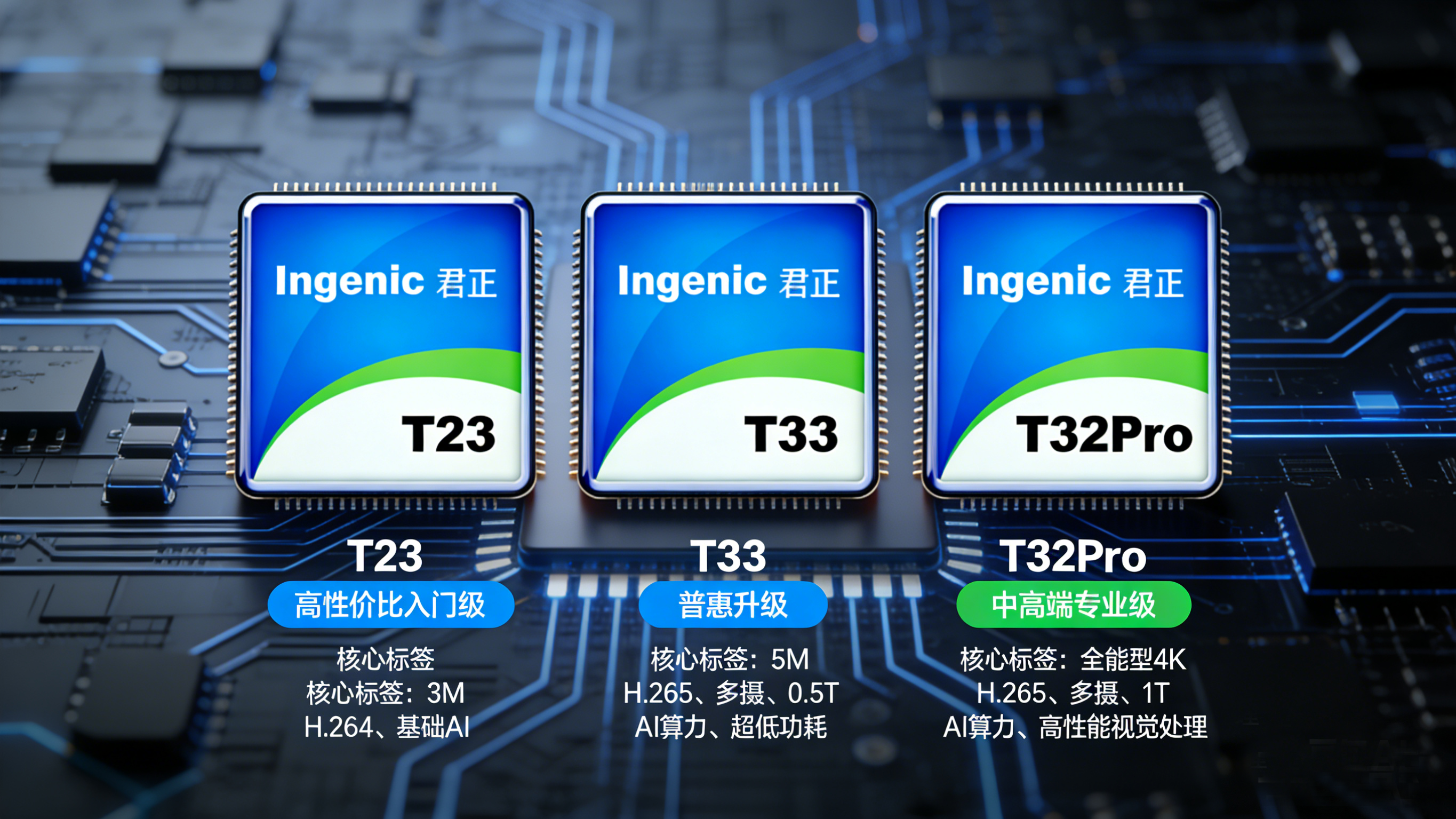
2.1 T23 Series: High-Cost-Performance Entry-Level [Core Tags: 3M H.264, Basic AI】
Core positioning is for low-cost intelligent vision applications, with "ultimate cost-performance" as its core advantage. It has high competitiveness in the H.264 product segment. Although it lacks an independent NPU, it can support basic algorithms like human detection and motion detection by leveraging the high-performance CPU. It is the optimal solution for basic vision scenarios with no complex AI requirements and high cost sensitivity.
Hardware configuration is basic-level. It can support dual-camera 3M products via MIPI-Switch expansion. It supports semi-direct pass-through memory-saving technology, resulting in low media memory usage. It integrates basic vision processing functions, meeting the development needs of entry-level security cameras and home camera devices.
Hardware supports LZMA hardware decompression, offering better power consumption control and startup speed compared to the previous generation T31. The RISC-V co-processor accelerates AE+AWB convergence, adapting to low-power product scenarios.
2.2 T33 Series: Inclusive Upgrade [Core Tags: 5M H.265, Multi-Camera, 0.5T AI Computing Power, Ultra-Low Power]
Core positioning is as an entry-level H.265+AI SoC. It is a comprehensive upgrade of the T23 and a more accessible version of the T32Pro. It integrates an H.265 high-efficiency encoder and a 0.5T independent NPU, with "low power consumption + high image quality + inclusive AI" as its core advantages, breaking down the application barriers of high-end AI vision technology.
Hardware natively supports 2x2 Lane multi-camera setups and 5M sensor input. Vision processing is significantly upgraded, featuring the professional-grade Tiziano-v4.1 ISP, which optimizes image quality in RAW domain noise reduction, purple fringe correction, and false color removal, offering better noise control in low-light scenes. The Hera-v1.6 encoder achieves stable encoding at 6MP@25fps, with full-mode coverage for bitrate control, balancing image quality and bandwidth cost.
Power consumption is greatly optimized. In Atlas (AOV) mode, single-camera 2M@1FPS power consumption is as low as 26mW (including Sensor). In 4MP+D1@15fps H.265 operation scenarios, power consumption is reduced by 25% compared to T32. It perfectly adapts to power-sensitive scenarios such as battery-powered cameras, smart door lock front-ends, and solar-powered outdoor cameras.
Full compatibility features: Pin-to-Pin hardware compatible with T32/T32Pro, shares SDK development resources, can be combined with T32Pro to meet different tier product needs, significantly shortening product R&D cycles.
2.3 T32Pro Series: Mid-to-High-End Professional Grade [Core Tags: All-Round 4K H.265, Multi-Camera, 1T AI Computing Power, High-Performance Vision Processing]
Focuses on high-performance vision processing. Supports 4K@30fps H.265 ultra-high-definition encoding, dual 4K@15fps / dual 5M@20fps multi-camera applications, and 2M@120fps high-frame-rate capture. Dynamic scene processing capability is outstanding, adapting to professional-grade high-definition surveillance needs.
Memory is further optimized, supporting 4K single-camera 512Mbit DDR solutions. It also comes with different built-in DDR specifications (512Mbit, 1Gbit, 2Gbit), adapting to the memory and bandwidth requirements of different scenarios like high resolution, multi-camera, and high frame rate.
Professional AI computing power and vision processing capability. Integrates 1 Tops@int8 NPU computing power, standard includes person/vehicle/pet detection, Mert, and other algorithms, supports the Magik algorithm development platform for AI algorithm application expansion tailored to differentiated scenarios. Integrates a new generation ISP, supporting advanced image processing functions like fisheye correction and dual-camera fusion/stitching, meeting the demands of high-end scenarios such as industrial vision analysis, 4K high-definition, and multi-camera fusion surveillance.
III. Application Scenario Adaptation Suggestions
Basic vision functions, extreme cost control: Recommended T23 Series. Adapts to scenarios like home ordinary cameras, economical IPCs, basic mobile cameras, etc., requiring only H.264 basic encoding and simple human detection, meeting cost-sensitive, basic AI, and high-definition needs.
Requires H.265+AI, power-sensitive / upgrade replacement: Recommended T33 Series. Adapts to scenarios like battery-powered cameras, AOV devices, smart door lock front-ends, solar-powered outdoor cameras, T32 upgrade replacements, etc. Core requirements are H.265 efficient encoding, rich AI (person/vehicle/pet detection, Mert), ultra-low power consumption, balancing cost-performance and development compatibility.
4K ultra-high-definition + professional AI + high-performance vision: Recommended T32Pro Series. Adapts to scenarios like 4K professional security surveillance, multi-camera fusion devices, industrial vision analysis terminals, high-end video analysis equipment, etc. Core requirements are 4K H.265 ultra-high-definition, high frame rate, professional-grade AI computing power, advanced vision processing, prioritizing performance requirements over cost.
IV. Technical Compatibility Explanation
Hardware Compatibility: The T33 series is Pin-to-Pin compatible with the T32Pro series. The T32Pro series maintains a unified package specification, facilitating hardware platform reuse across models.
Software Compatibility: The T33 series and T32Pro series share an SDK, supporting a three-in-one Normal/Battery/AOV SDK. Core drivers and application layer interfaces maintain consistency. Development resources can be reused across series, significantly shortening R&D cycles.